1930s–1950s · Network and syndicated spots
The Sponsors
The commercials themselves — Adam Hats, Alka-Seltzer, Anacin, Chevrolet, Lucky Strike — lifted off the shows they interrupted and heard on their own terms.
228 broadcasts
The Radio Planet presents
Every history of radio is written from the same shelf: the comedians, the detectives, the war correspondents. But a broadcasting day was mostly other things — the commercial, the schoolroom, the dance band on a hotel line, the quiz, the Sunday sermon, the fight, and the programmes that only existed because one independent station said yes. Those recordings survive. Almost nobody curates them. Here they are.
2,460
Broadcasts
22
Series
787h
Of audio
1930–1976
Years covered
The Sponsor Reel
Nobody preserves advertising on purpose, which is exactly why it survives as the most vivid time capsule radio produced. Spots, singing commercials, the jingle house that scored a dairy in four-part harmony, and the Treasury Department selling the war in fifteen-minute instalments.
1930s–1950s · Network and syndicated spots
The commercials themselves — Adam Hats, Alka-Seltzer, Anacin, Chevrolet, Lucky Strike — lifted off the shows they interrupted and heard on their own terms.
228 broadcasts
1950s–1960s · Allied Radio Artists
The output of a jingle house: local dairies, drug stores, lumber yards and ice cream parlours, each given a full singing arrangement.
116 broadcasts
1942–1944 · United States Treasury, syndicated
The Treasury Department's own syndicated series: stars, orchestras and original scripts, all of it built to sell war bonds.
136 broadcasts
1942–1945 · NBC and syndicated
Three survivors of the bond campaign itself: Orson Welles' appeals, an NBC bond parade from 1944, and Treasury interviews recorded with ordinary buyers.
3 broadcasts
Radio Goes to School
Fairy tales performed by child actors with a full orchestra, a talking fish at the bottom of the sea, and the last children's programme left standing after television took the rest.
1947–1953 · CBS
Nila Mack's Saturday morning company of child actors, doing the Grimm and Andersen repertoire straight, with an orchestra and no condescension.
74 broadcasts
1950s–1970s · ABC and syndication
Jon Arthur's Saturday morning programme and its serial, Sparkie — the little elf who wanted to be a real boy — which outlived nearly every other children's show on American radio.
288 broadcasts
1944–1948 · ABC / Mutual
Isabel and Billy travel down to the kingdom where lost things end up, guided by Red Lantern the talking fish. Gentle, strange and quietly educational.
34 broadcasts
The Music Room
Remote pickups from hotel ballrooms, camp shows for the forces, and the AFRS series that recorded the greatest Black musicians in America because the commercial networks would not.
1942–1949 · Armed Forces Radio Service
AFRS's series for Black servicemen: Ellington, Armstrong, Basie, Lena Horne, Nat Cole and the best small groups in Los Angeles, playing at length and unedited.
219 broadcasts
1943–1945 · Armed Forces Radio Service
Late-night dance broadcasts picked up from hotel ballrooms and pavilions — Spivak at the Palladium, Shep Fields at the Park Central, Glen Gray at Tune Town — and rebroadcast to the forces.
86 broadcasts
1941–1945 · Mutual, then Blue Network / ABC
Coca-Cola sent the top bands in the country to army camps and defence plants and broadcast whatever happened — Miller, Goodman, Dorsey, Ellington, Kyser.
60 broadcasts
1944–1948 · NBC and syndication
Chesterfield Supper Club with Perry Como, Martin Block's Make Believe Ballroom and the Fitch Bandwagon — the nightly music strip in its natural form.
14 broadcasts
Sport on the Air
Live sport went out once and vanished. What is left is a storyteller who frequently made it up, and one station air check of a fight in 1936 that somebody happened to keep.
1939–1951 · NBC
Fifteen minutes of sporting anecdote delivered with total conviction and a guest each week — Babe Ruth, Sinatra, Dorsey, Rudy Vallee — by a man whose relationship with fact was famously flexible.
161 broadcasts
1936 · KHJ, Los Angeles
A KHJ air check of Joe Louis against Jack Sharkey, 18 August 1936 — the kind of live commentary that was almost never recorded because nobody thought to.
1 broadcast
The Quiz and the Giveaway
The panel nobody could stump, the stunt show that made the forfeit the whole point, the touring quiz that set up in a different theatre every week, and five children who could out-answer any adult in the room.
1938–1951 · NBC Blue, then Mutual
Clifton Fadiman, a permanent panel of formidable minds and a weekly guest — Oscar Levant, Gracie Allen, Wendell Willkie — answering questions sent in by listeners for two dollars a go.
219 broadcasts
1940–1950 · NBC
Ralph Edwards asked an impossible question, the contestant failed, and then had to imitate an aeroplane or hold crackers in their mouth in front of a delighted studio audience.
16 broadcasts
1939–1949 · NBC / Mutual
The travelling quiz: assistants roamed a theatre audience with microphones, the Doctor asked from the stage, and silver dollars were handed out on the spot.
8 broadcasts
1940–1953 · NBC Blue / ABC / CBS
Joe Kelly, who left school at ten, chairing a panel of children with terrifying general knowledge, weekly guests and a sponsor selling breakfast oats.
76 broadcasts

1942–1960 · NBC
The stunt show at full strength: participants sent on absurd errands into the streets of Los Angeles, with the results reported back on air.
25 broadcasts
Faith on the Air
A priest who talked Mutual into donating a half hour and Hollywood into working for nothing, and a tyre company that paid for nine years of network drama on condition its name was never mentioned.
1947–1957 · Mutual
Father Patrick Peyton persuaded Hollywood to work for nothing and Mutual to give away the time — Bing Crosby, Loretta Young, Jimmy Stewart, Gregory Peck — for ten years of unsponsored drama.
528 broadcasts
1947–1956 · ABC
Goodyear paid for the whole run and refused to have its name attached to a single episode — an unbilled sponsorship unique in American broadcasting.
76 broadcasts
Voices Not on the Networks
Made at independent and local stations, decades ahead of the networks, and preserved almost by accident: Richard Durham writing Black history as weekly drama in Chicago, and WMCA giving New York a standing argument about race.
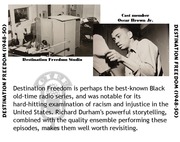
1948–1950 · WMAQ, Chicago
Ninety-odd scripts on Denmark Vesey, Harriet Tubman, Ida B. Wells, Satchel Paige and Richard Wright — written by Durham, produced in Chicago, and unlike anything else on American radio.
45 broadcasts
1944–1957 · WMCA, New York
A New York independent station gave over a weekly half hour to Black life and Black argument — fascism and democracy, the ghetto, the war, the vote — with Canada Lee narrating.
47 broadcasts
Every recording on this page is a real surviving transmission or transcription held by the Internet Archive and in the public domain. Titles, dates, networks and durations come from the archives’ own metadata; where a source gives no date the broadcast is filed as undated rather than guessed at. Cover cards are set in type here, from the facts of each series. Nothing is reconstructed, and no artwork is generated.